Make Friends Think You Can Read Minds in Three Sentences? Unpacking the Source Code of the 'Barnum Effect'
This is a tutorial on 'deception,' but don't worry—it's completely legal.
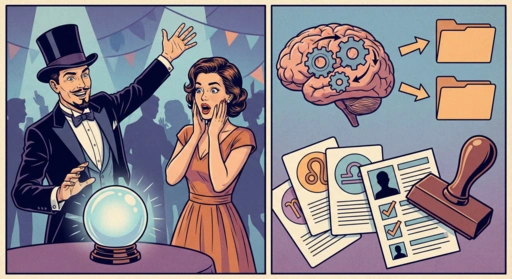
Imagine you're at a party. You gaze deeply at a new friend you've just met, frown slightly, and then say:
"I feel like you've been really exhausted lately. Although you always seem cheerful and are the life of the party to others, when the night gets quiet, you often doubt yourself and feel that no one truly understands your inner anxiety."
Trust me, there's a 90% chance their eyes will widen, and they might even grab your hand excitedly and say, "Oh my god! How did you know? That's so accurate!"
Congratulations. You have just successfully executed a "Barnum Attack." You didn't read their mind; you simply exploited a huge bug in the human brain—the Barnum Effect.
Today, we're not going to talk about dry textbook definitions. We're going to dissect it like a magic trick and see why even well-educated people like us can be moved to tears by these ambiguous, seemingly nonsensical sentences.
Step 1: The "Schrödinger" Personality Description
Why are those personality quizzes and horoscopes so scarily accurate? Because they've mastered a core technique: saying two contradictory things at the same time and making them both seem true.
It's like "Schrödinger's cat"—until the box is opened, your personality is both A and B.
Psychologist Bertram Forer played this trick back in 1948. He gave all his students the same personality analysis, filled with sentences like: "You are very extroverted, but sometimes you are also very introverted," and "You love freedom, but at times you also crave security."
Logically, this is nonsense. Who isn't sometimes extroverted and sometimes introverted? Who doesn't sometimes want to spend money and sometimes want to save? But when this nonsense is packaged as a "test result," our brains automatically ignore the logical loopholes and activate the "Subjective Validation" mechanism. We automatically rummage through our brain's memory bank to find an experience where "I was really introverted that one time," just to prove the statement right.
We are not reading an analysis report; we are filling in the blanks ourselves.
Step 2: Selling the Placebo of "Unappreciated Talent"
If you look closely at the viral personality quizzes on the market, you'll find they will never say: "You're actually not very smart and are naturally lazy."
Instead, they will say: "You have a great deal of undeveloped potential," or "Your intuition is very strong, but it's often suppressed by your reason."
This is the second engine of the Barnum effect: the Pollyanna Principle (also known as the positivity bias). Humans are somewhat narcissistic; we crave compliments but dislike overly blatant flattery.
The brilliance of Barnum statements lies in giving you a high-quality compliment—a feeling of being a "hidden gem with unappreciated talent." It implies: "You haven't become your best self yet because the world hasn't discovered your potential." This is practically a spiritual opium for the modern age. In this era of extreme competition and anxiety, who wouldn't want to hear, "Actually, you're amazing, you just haven't had your chance to shine yet"?
So, personality quizzes don't sell "accuracy"; they sell "comfort."
Step 3: Finding Order in Chaos
Now that we've debunked these tricks, why do we still click on "Test Your Soul Shape" the next time we see it?
This touches upon a deeper psychological need. From an evolutionary psychology perspective, the brain hates "randomness" and the "unknown." An unknown jungle represents danger, and an unknown future represents anxiety.
When the MBTI tells you "You are an INFP," or a horoscope warns you to "be careful with communication during Mercury retrograde," it's like finding a piece of driftwood in a chaotic universe. Even if this driftwood is made of paper, it can provide a momentary sense of security.
We love taking tests because we long to be defined. In a society where labels are torn apart, having a simple "manual" that tells us "who I am" and "what I should do" is a huge relief. We'd rather believe in an imperfect label than face the complex and unpredictable true self.
Conclusion: Enjoy the Game, but Keep the Remote in Your Hand
Understanding the Barnum effect isn't about turning you into a cynical person who points at a friend's phone and yells, "That's fake!" On the contrary, it's a form of "soberly aware" entertainment.
You can still enjoy personality quizzes, just like watching a magic show—you know it's fake, but you still applaud the clever techniques. When the test result says you are a "gentle yet determined warrior," by all means, accept the compliment and let it motivate you for the day.
But remember: you are a complex, multi-faceted, contradictory, and unique individual. Don't let a few lines of generic, canned code or a circus script from a hundred years ago box in your self-perception.
What truly defines you are not those ambiguous test results, but every specific choice you make, every single day.
Now, you can try saying that classic Barnum line to a friend. Just remember—don't break character and laugh.